The Only Laundry Routine That Actually Works (Even for Big Families)
Struggling to keep up with laundry? This realistic laundry routine helps busy families stay ahead without spending hours folding. Simple system, fewer loads, less stress.

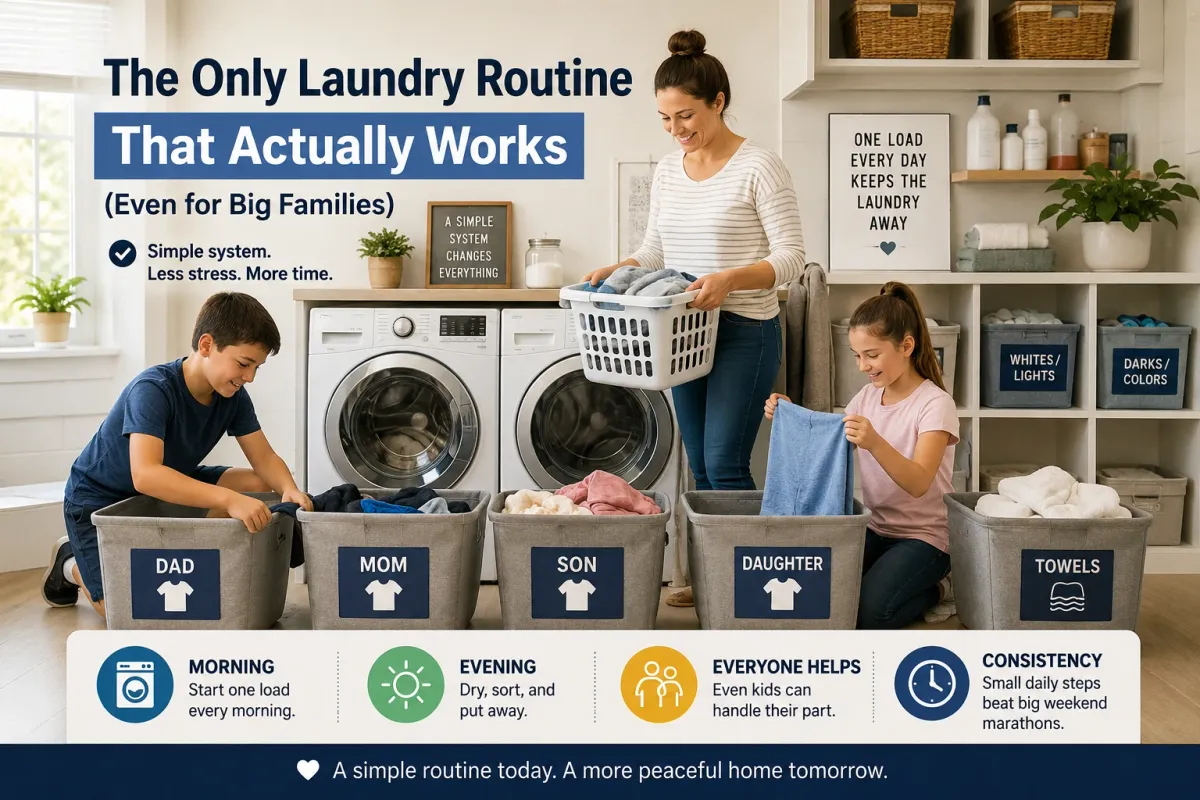
Laundry never really “ends,” does it?
You run a load.
You fold a pile.
You turn around… and the hamper is full again.
If you have a big family, you already know:
It’s not just laundry. It’s a cycle that quietly eats your weekends.
Let me say this upfront.
Conclusion first: A simple daily laundry routine beats any “catch-up” strategy.
If you’re constantly behind, the problem isn’t the size of your family.
It’s the structure.
In most cases, trying to “do all the laundry” in one or two big sessions is exactly why it keeps piling up. A small, fixed daily system works better — even for large households.
You could stop reading here and try this:
- One load every morning
- Dry + quick put-away every evening
- No marathon folding sessions
That alone changes everything.
Now let me explain why.
Why Most Laundry Routines Fail
Most families treat laundry like a project.
“We’ll handle it Saturday.”
“I’ll catch up tomorrow.”
I used to do the same.
By the time Saturday came, there were 6–8 loads waiting. Just looking at the piles was exhausting. And once you’re mentally tired, you move slower. You avoid it. You procrastinate.
That’s where the cycle begins.
Laundry isn’t a project.
It’s maintenance.
And maintenance only works when it’s predictable.
The Daily Laundry System That Actually Works
Here’s the structure that finally worked in our home.
1. Morning Load Strategy
Every morning, one load goes in. No decision-making.
Not “if it’s full enough.”
Not “if I feel like it.”
Just one load.
Whites + lights together.
Everything else together.
Towels separate when needed.
Three categories. That’s it.
Over-sorting slows you down. Most everyday clothes can handle mixed washing. Mesh bags solve the delicate problem without creating five extra piles.
Less sorting = less delay.
2. Evening Reset Method
In the evening:
- Move to dryer (or hang dry)
- Quick sort
- Put away immediately
Not perfectly. Immediately.
This is where people get stuck.
Folding becomes a performance.
Instagram-level stacks. Perfect corners. Matching everything.
In a big family, efficiency beats aesthetics.
Towels? Stack them unfolded in a basket.
Kids’ clothes? Straight into labeled bins.
Underwear? Drawer dividers. No folding ceremony.
When I stopped chasing “perfect,” we gained hours back every week.
How to Reduce Folding Time by 50%
Let’s be honest.
The washer isn’t the time problem. Folding is.
If you want speed, remove unnecessary steps.
- Give each child their own laundry bin
- Teach kids 6+ to put away their own clothes
- Teens handle their own load once a week
- Stop folding what doesn’t need folding
At first, it feels messy.
But here’s what surprised me: after two weeks, it felt normal.
And normal is what you want.
You don’t need a better washer.
You need fewer decisions per load.
Laundry Schedule for Families Who Always Feel Behind
If you’re already drowning in laundry, don’t start with perfection.
Start with reset mode.
For one week:
- Commit to one load per day
- No backlog sorting
- No deep organization
- Just forward motion
This isn’t about catching up.
It’s about stabilizing.
Once the daily rhythm locks in, the mountain shrinks on its own.
Right now, you might be thinking:
“But what if one load a day isn’t enough for us?”
That’s fair.
In very large households, two smaller daily loads can work better than one massive weekend session. The principle stays the same: small, predictable cycles beat chaotic marathons.
Start Here (Today)
If you want this to move faster immediately, do just three things:
- Reduce sorting to three categories
- Run one load every morning, no exceptions
- Put everything away the same day — imperfectly
That’s it.
No new appliances.
No complicated laundry room makeover.
No five-step color-coded spreadsheet.
Just structure.
Final Thought
Laundry stress usually isn’t about volume.
It’s about decision fatigue.
When you remove the decisions, the system runs itself.
So here’s the real question:
Are you going to keep managing laundry…
Or are you ready to design it once — and stop thinking about it every weekend?
Frequently Asked Questions
1. How often should a large family do laundry?
In most cases, daily is better than weekly.
Trying to “catch up” once or twice a week usually leads to 6–8 overwhelming loads. A small daily cycle keeps volume controlled and prevents decision fatigue.
If your household has 5+ people, one load per day is usually the minimum baseline. Larger households may need two smaller daily loads.
Consistency beats intensity.
2. Is it better to sort laundry by person or by color?
For speed, sort by category — not by person.
Whites/lights together.
Everything else together.
Towels separate.
Sorting by individual slows the process and increases mental load. Personal bins should be used after washing, not before.
If your goal is faster laundry, reduce sorting decisions first.
3. What’s the fastest way to fold laundry?
Stop folding everything.
Towels can be stacked unfolded.
Kids’ everyday clothes can go straight into bins.
Underwear doesn’t need precision folding.
In large families, “good enough” is usually more sustainable than perfect.
If folding is taking more than 15–20 minutes per load, the system needs simplifying.
4. Do I need a bigger washing machine for a big family?
Not necessarily.
In many homes, the real bottleneck isn’t capacity — it’s backlog.
Before upgrading appliances, try a 7-day daily load reset. If laundry still overflows despite consistency, then capacity might be the issue.
But most of the time, structure fixes more than hardware.
5. How do I keep laundry from piling up again?
Remove decision points.
Set a fixed time (morning start, evening reset).
Limit sorting categories.
Make everyone responsible for their own part.
Laundry piles up when it’s optional.
It stabilizes when it’s automatic.
6. What if I already feel completely behind?
Don’t try to “finish everything.”
Start with forward motion.
One load per day. No deep organizing. No perfection. Just momentum.
Once rhythm replaces overwhelm, the backlog naturally shrinks.
7. Is a laundry schedule really necessary?
If you’re constantly behind — yes.
A loose “I’ll do it later” plan works for small households.
For large families, structure prevents mental clutter.
You don’t need a complex chart.
You need a predictable rhythm.
Laundry won’t magically get easier.
But it can get simpler.
Start tomorrow morning.
One load. No debate. No overthinking.
If you’ve read this far, you already know what needs to change.
The only question left is this:
Will you keep managing the chaos —
or finally install a system that runs without you?
 HOON JUNG