Why Your First Midwest Investment Might Break Your Heart (And Your Budget)
Forget the spreadsheets. Buying Midwest C-class rentals isn't about the numbers on your screen—it's about the management nightmare you haven't accounted for yet. Here is the cold, hard truth on whether you should actually buy.

When I first crunched the numbers, I almost fell in love.
An 8% annual return? In this economy, where 4 or 5% is considered a win, that felt like a miracle. I could practically see it: the steady flow of monthly rent, the quiet satisfaction of building wealth without the headache of debt. It felt like the opening scene of a rom-com where everything goes perfectly according to plan. The low-cost, single-family homes in the American Midwest were practically whispering, "I’m the hidden gem you’ve been looking for."
But as anyone who has navigated both a spreadsheet and a real life knows, reality rarely stays inside the lines of an Excel file. Real estate is where cold numbers meet messy, unpredictable human beings. And that’s where the drama begins.
The "Calculator" Romance
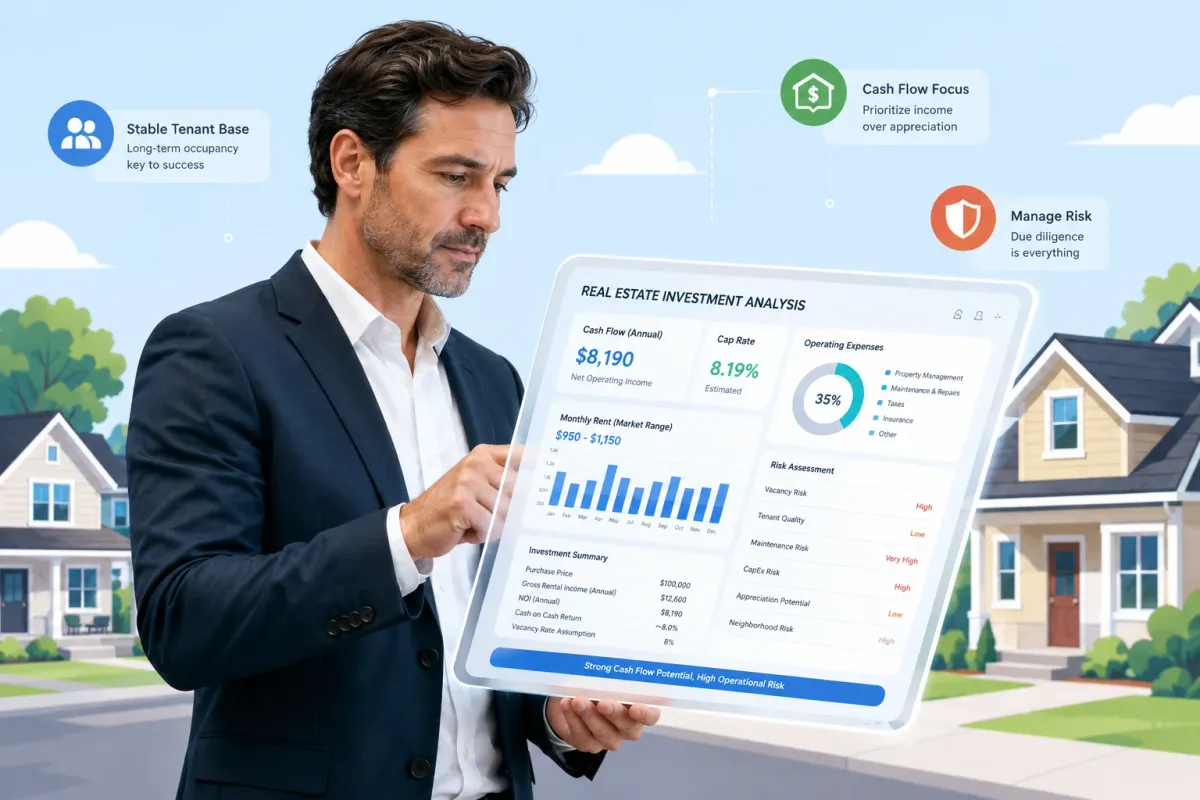
Let’s look at the math: $1,050 in rent, 8% vacancy, 35% in operating expenses. A nice, clean Net Operating Income (NOI) of about $8,190. If the purchase price is $100,000, that gives you an 8.2% cap rate. On paper? It’s a dream. But the problem with paper is that it doesn’t account for the reality of a leaky roof or a tenant who just stopped paying.
The Risks They Don’t Put in the Brochure
There’s a reason C-class markets offer such high yields. It’s the "risk premium." Tenants move, rent gets late, and evictions are a headache you didn't budget for. The moment a vacancy stretches out, that glorious 8% return starts to look more like a mirage.
And the house itself? Even a "fully renovated" home has secrets—old plumbing, outdated electrical, a roof that’s just waiting for a storm to retire. A $5,000 roof repair might look like a line item on a calculator, but in reality? It’s a year’s worth of profit vanishing in an afternoon. These are the details that are conveniently left out of the investment pitch.
So, Is It a Good Buy?
We’re all chasing two things: monthly cash flow and appreciation. But C-class properties are notoriously one-sided. They’re great for the former, but a bit shy about the latter. In a downturn, these are the neighborhoods where the market freezes solid. And let me tell you, there is nothing quite as frustrating as needing to sell something that nobody wants to buy.
The Verdict: Systems Over Sparkles
If you have a rock-solid local management team on the ground, maybe you can make this work. If you have a reliable network of contractors and the stomach to handle the unexpected, this could be a sturdy little engine for your portfolio.
But if you’re like me—trying to manage all of this remotely? Take a step back. Chasing $1,000 in rent isn't worth the mental toll when two months of vacancy and one major repair turn your "passive income" into a full-time nightmare.
Before you buy, don't look at the projected yields. Look at the ledger. Has the current tenant paid their rent on time for the last six months? Because at the end of the day, a property’s value isn't defined by the building itself—it’s defined by the people inside who actually pay the rent.
High cash flow is undeniably sexy. But it only becomes a "good investment" when you have the system to back it up. Don't be fooled by the high yields; remember, the Midwest doesn't just demand your money—it demands your management. And sometimes, the most beautiful numbers are the ones that are actually telling you to walk away.
Frequently Asked Questions (FAQ)
Q: Is it possible to make money in Midwest C-class real estate? A: Yes, but only if you have a battle-tested local management system. If you think it will be truly "passive" without professional boots on the ground, you are setting yourself up for financial loss.
Q: What is the biggest hidden cost in these properties? A: Unexpected capital expenditures (CapEx). A single roof replacement or HVAC failure can wipe out your entire year's worth of rental income in one day.
Q: Should I buy a property if the Cap Rate is over 8%? A: Never buy based on Cap Rate alone. A high Cap Rate in a C-class neighborhood is usually a "risk premium"—it’s the market’s way of warning you that the property is difficult to manage and prone to vacancy.
Q: How do I verify if a property is a good investment? A: Ignore the pro-forma numbers and ask for the rent roll. If the current tenants haven't been paying consistently for the last 6–12 months, no amount of "discounted purchase price" can save that investment.