Your 2.5% Mortgage Is Practically a Unicorn. So... Should You Sell Your House or Rent It Out?
You secured a rare 2.5% mortgage, but now you're moving. Should you sell or rent? This guide compares taxes, cash flow, appreciation, landlord risks, and opportunity costs to help you choose the smartest financial path with confidence.


A California homeowner's dilemma.
There are good problems, and then there are 2.5%-mortgage problems.
If you bought a home during the golden age of ultra-low interest rates, you've probably caught yourself smiling every time you look at your monthly payment. A mortgage that starts with a two feels almost mythical these days.
But life has a habit of changing the plan.
Maybe you've accepted a job in another state. Maybe you're moving back to Korea. Maybe your family simply needs a different home.
Suddenly, you're standing at a crossroads, staring at a house that's become both a home and a financial asset.
Let's imagine this situation:
- Current home value: $1.6 million
- Mortgage rate: 2.5%
- Monthly mortgage payment: about $2,500
- Potential monthly rent: around $5,000
So what's the smarter move?
Do you hold onto the house and become a landlord?
Or do you sell, lock in your gains, and move on?
There isn't a universally correct answer—but there are two very passionate camps.
Team "Keep the House"
Their argument is simple:
You don't let go of a once-in-a-generation mortgage.
1. That 2.5% loan is an asset all by itself.
Today's mortgage rates make 2.5% feel like finding concert tickets from 1998 at face value.
If your mortgage costs roughly $2,500 a month while the property rents for around $5,000, you've got leverage that most buyers today simply can't recreate.
You aren't just owning real estate.
You're holding a financing advantage that's almost impossible to replace.
2. Great locations tend to stay great.
If the property appreciated from around $1 million to $1.6 million, chances are it sits in a desirable California market.
No one owns a crystal ball, but historically, well-located homes in strong employment centers have rewarded patient owners over long periods.
Selling now might feel a little like cutting down the tree that's finally started producing fruit.
3. Higher-end tenants often treat the property differently.
Many landlords point out that tenants paying $5,000-$6,500 per month are frequently professionals with stable incomes.
While there are certainly exceptions, these renters often maintain the home well and may handle minor maintenance themselves rather than calling for every squeaky hinge.
It's not a guarantee.
But it can make ownership feel less intimidating.
"What if I'm moving far away?"
That's exactly why property management companies exist.
For roughly 8-10% of the monthly rent, a management company can advertise the property, screen tenants, collect rent, coordinate repairs, and handle the day-to-day headaches that come with being a landlord.
For many owners, paying someone else to answer the midnight plumbing call is money well spent.
Team "Sell It and Sleep Better"
The other side has a different philosophy.
Money matters.
Peace of mind matters too.
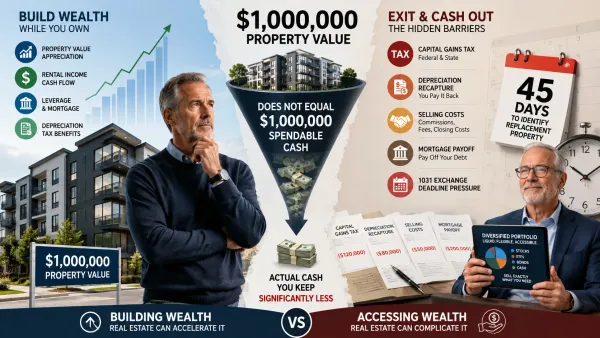
1. Don't overlook the capital gains tax exclusion.
If you've lived in the home as your primary residence for at least two of the last five years, U.S. tax law may allow you to exclude up to:
- $250,000 of capital gains (single)
- $500,000 (married filing jointly)
That's an incredibly valuable benefit.
Convert the home into a long-term rental, and that tax advantage may become much harder—or impossible—to capture later.
Waiting for more appreciation could eventually mean sharing a much larger portion of your profit with the IRS.
2. Rental income isn't pure profit.
It's easy to look at the numbers and think:
"$5,000 coming in minus $2,500 going out... I'm making $2,500 every month."
Not quite.
Reality usually includes:
- Property management fees
- Property taxes
- Homeowners association dues
- Landlord insurance
- Repairs and maintenance
- Vacancy periods
- Unexpected expenses
After everything is paid, annual cash flow may be much smaller than it first appears.
3. California isn't always landlord-friendly.
California has gradually strengthened tenant protections.
That can create additional challenges for landlords, especially those living in another state—or another country.
A great tenant can make owning rental property feel wonderfully effortless.
A terrible tenant can make it feel like a second full-time job.
Distance only magnifies that stress.
4. Opportunity cost is real.
Selling the home could free up a substantial amount of equity.
Some homeowners would rather invest that money in broadly diversified index funds or dividend-focused portfolios than continue managing a rental property.
For them, liquidity, simplicity, and flexibility are worth far more than squeezing every possible dollar from real estate.
Sometimes the best investment is the one that lets you sleep through the night.
A Quick Side-by-Side Comparison
Keep the House
Pros
- Preserve an exceptionally low mortgage rate
- Continue benefiting from long-term appreciation
- Potential monthly cash flow
- Build additional equity over time
Cons
- Tenant risk
- Ongoing maintenance
- Property management costs
- Future tax considerations
Sell the House
Pros
- Potential capital gains tax exclusion
- No landlord responsibilities
- Greater liquidity
- Easier diversification into stocks or other investments
Cons
- Give up a historically low mortgage
- Miss potential future appreciation
- Hard to buy back into today's housing market
So... What Would You Do?
At its heart, this isn't really a math problem.
It's a lifestyle problem wearing a spreadsheet as a disguise.
Some people value maximizing long-term wealth.
Others value simplicity, flexibility, and fewer things keeping them awake at 2 a.m.
If you're genuinely undecided, there's one practical strategy that many homeowners consider:
List the property for both sale and rent at the same time.
If an excellent buyer appears with an attractive offer, you sell.
If a highly qualified tenant comes along first, you keep the property.
Sometimes the market makes the decision for you.
After all, houses aren't just investments.
They're where birthdays happened. Where moving boxes became furniture. Where ordinary Tuesdays quietly turned into memories.
Whether you keep yours or let it become someone else's home, the right answer is usually the one that fits not only your balance sheet—but the life you're trying to build next.