I Learned This $20,000 Payroll Card Mistake the Hard Way—Don't Repeat It
Many workers treat payroll cards like bank accounts without realizing the risks. A real-life medical emergency revealed how difficult it can be to access funds when corporate policies collide with legal authority. Here's why keeping large balances on your ADP Wisely card may be a costly mistake.

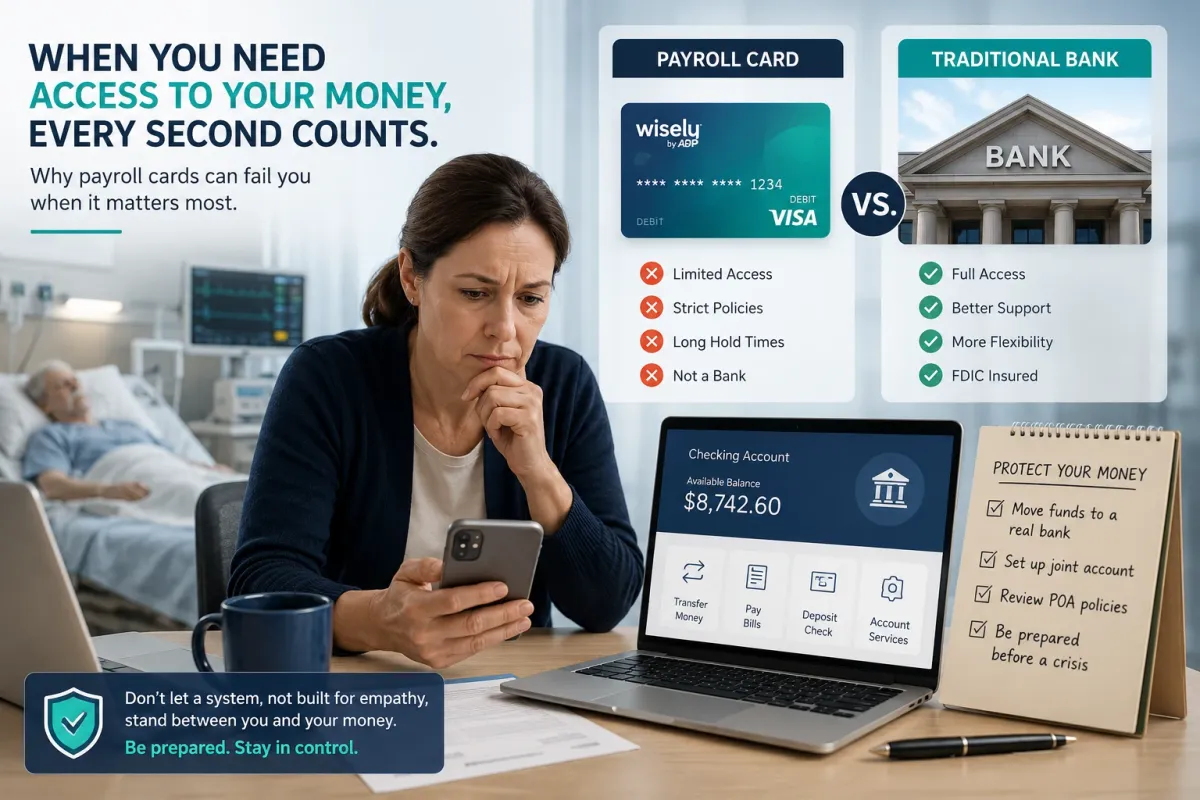
A medical emergency taught me a lesson I wish I had learned sooner.
Let me start with the conclusion.
If you're getting paid through an ADP Wisely card and keeping a significant amount of money on it, move that money to a traditional bank account as soon as possible.
Not tomorrow.
Not when you "get around to it."
This week.
I didn't always think this mattered. Like many people, I assumed a payroll card was simply a modern way to receive and manage money. Your paycheck arrives. You can spend it, transfer it, withdraw it. Simple.
Until real life happens.
And that's when you discover the difference between having access to your money and actually controlling it.
The Day Convenience Stopped Being Convenient
A close family member was hospitalized unexpectedly.
They were unconscious and unable to communicate.
Fortunately, I had something many families don't think about until it's too late: a legally executed Power of Attorney.
I had the notarized documents.
I had identification.
I had proof of address.
I had spent months making sure everything was legally correct.
In other words, I had done exactly what responsible adults are told to do.
Yet every conversation with customer service felt like running into the same brick wall.
"We need to speak directly with the account holder."
"We require the account holder's ID."
"We cannot process that request."
The responses never changed.
Neither did the outcome.
When Legal Authority Meets Corporate Policy
Here's what surprised me.
Under Ohio law, a valid Power of Attorney allows an agent to act on behalf of the principal. In practical terms, you're authorized to make decisions and manage financial affairs when the account owner cannot.
At least that's the legal theory.
The corporate reality can be very different.
What I learned is that many financial service platforms aren't designed to evaluate complicated human situations. They're designed to minimize risk.
And when a company must choose between helping a customer and avoiding potential liability, risk avoidance usually wins.
Every time.
The Part That Made No Sense
This is where the situation became almost absurd.
After reviewing the documentation, they mailed a replacement card to my address.
They allowed a PIN reset.
They recognized enough authority to issue access credentials.
But when I attempted to move funds electronically for urgent medical expenses?
Denied.
Think about that for a moment.
I was effectively given access to the front door but locked out of the room where the money actually sat.
As a result, the only option available was withdrawing cash through daily ATM limits.
Day after day.
While medical bills continued arriving.
It felt less like financial services and more like navigating a maze designed by compliance officers.
The Real Problem With Payroll Cards
This experience isn't really about one customer service representative.
It's about a larger structural issue.
Payroll cards are excellent for receiving wages.
They're far less reliable when life becomes complicated.
Here are three reasons why.
1. They're Not Traditional Banks
Many people treat payroll cards like checking accounts.
They're not.
While they offer banking-like features, they're often governed by different systems, policies, and support structures.
When unusual situations arise, the level of flexibility may be dramatically different from what you'd expect from a local bank or credit union.
2. Risk Management Comes First
Most large organizations optimize for consistency.
Not exceptions.
A medical emergency may be the most important thing happening in your life.
Inside a corporate compliance framework, it's simply another case file.
That's not cruelty.
It's bureaucracy.
And bureaucracy rarely moves at the speed of a crisis.
3. Convenience Creates a False Sense of Security
This is the biggest lesson I learned.
Something can be convenient without being resilient.
Payroll cards are convenient.
But convenience should never be confused with preparedness.
The financial tools that work perfectly during normal circumstances can become surprisingly fragile when life goes off script.
What I Would Do Differently
If I could go back, I would make two changes immediately.
First, I would transfer excess funds from payroll cards into a traditional bank account on a regular basis.
Second, I would verify exactly how my financial institutions handle Powers of Attorney before an emergency occurs.
Not after.
Before.
Because when a crisis arrives, you're no longer researching policies.
You're living with them.
Frequently Asked Questions
Is the ADP Wisely Card a bank account?
No. The ADP Wisely Card functions as a prepaid payroll card, not a traditional checking or savings account. While it offers banking-like features, its policies and support systems may differ significantly from those of traditional banks.
Is it safe to keep all my money on a payroll card?
For most people, no. Payroll cards are convenient for receiving wages, but keeping large balances on them can create access challenges during emergencies, disputes, or account verification issues.
Can a Power of Attorney access funds on a payroll card?
It depends on the card issuer's policies. Even with a legally valid Power of Attorney, additional documentation or internal approval processes may be required before account access is granted.
What is the best alternative to a payroll card?
A traditional checking account or credit union account is generally a more flexible option for long-term money management, emergency access, and estate planning purposes.
How much money should I keep on a payroll card?
A practical approach is to keep only the amount needed for short-term spending and transfer the remaining funds to a traditional bank account regularly.
What should families do before a financial emergency happens?
Review account access policies, establish appropriate legal documents, understand Power of Attorney requirements, and consider joint banking arrangements where appropriate.
Why do payroll card providers sometimes deny access requests?
Most providers prioritize fraud prevention and compliance procedures. As a result, unusual situations may trigger restrictions even when legal documentation exists.
What is the biggest lesson from this experience?
Having money and having access to money are not always the same thing. Financial preparedness means ensuring your funds can be reached when life doesn't go according to plan.
Final Thought
Most people don't think about financial access until they lose it.
I didn't.
The uncomfortable truth is that having money and being able to use money are two very different things.
If your paycheck lands on a payroll card, that's fine.
But don't mistake a payroll card for a long-term financial home.
One unexpected hospital visit, one family emergency, or one bureaucratic roadblock can reveal weaknesses you never knew existed.
And by then, it's usually too late to prepare.
Have you ever run into similar issues with payroll cards, prepaid accounts, or financial institutions during an emergency?
I'd be interested to hear your experience.