The $100,000 Mistake Hidden in Your Browser Tabs (Most Investors Miss It)
Most real estate investors think they're analyzing deals. They're actually managing browser tabs. Here's why endless research kills decision-making—and how top investors find better opportunities faster by simplifying their workflow.

One day, I had an uncomfortable realization.
I wasn't acting like a real estate investor.
I was acting like a browser tab collector.
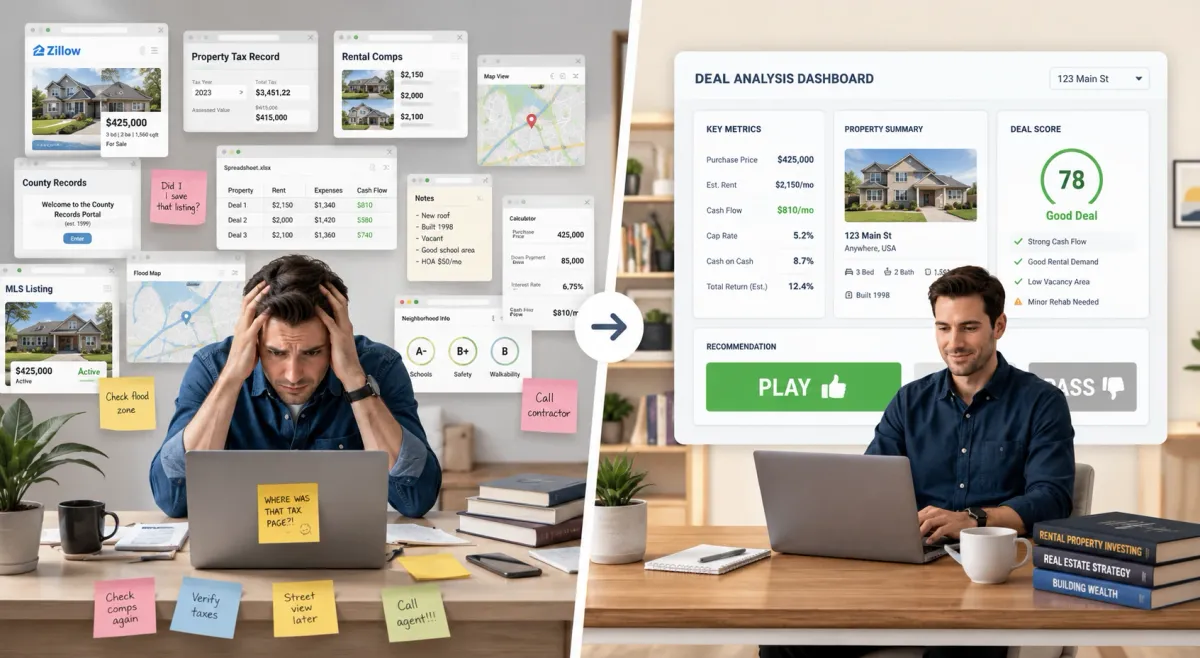
There was Zillow. Property tax records. Rental comps. Google Street View. A county records website that looked like it had survived the Y2K scare and never changed again.
Fifteen tabs were open.
Maybe twenty.
At some point, I stopped looking for a good deal and started trying to remember which tab contained which piece of information.
The funny thing?
I felt incredibly busy.
Productive, even.
But at the end of the day, I hadn't actually made a single decision.
And if you're a real estate investor, there's a good chance you've been there too.
We become very good at looking productive. We gather data. We compare numbers. We check one more listing, one more neighborhood, one more tax history.
We tell ourselves:
"Just one more property."
"Just one more comp."
"There's probably something important I'm missing."
But most of the time, that "one more thing" doesn't make us smarter.
It just makes us tired.
Data Gathering Isn't Deal Analysis
This took me longer to learn than I'd like to admit.
For years, I believed the investor with the most information had the advantage.
More data.
More tabs.
More research.
More certainty.
At least, that was the theory.
In reality, when twenty tabs are open, your brain isn't analyzing returns.
It's trying to remember where everything is.
Which tab had the rent estimate?
Where was that tax assessment?
Did I save the property notes somewhere?
Instead of evaluating the deal, you're managing context.
And context-switching is expensive.
Not financially.
Mentally.
The more energy you spend tracking information, the less energy you have available to make decisions.
The Three Things That Changed Everything
Eventually, I had to admit that my workflow wasn't helping me.
It was exhausting me.
So I made a few simple changes.
Nothing revolutionary.
Just enough to stop making things harder than they needed to be.
1. I Separated Collecting from Thinking
I used to gather information and analyze it at the same time.
It felt efficient.
It wasn't.
Now I collect data first.
I gather the numbers, organize the facts, and put everything in one place.
Then I close the browser.
Actually close it.
Only then do I start analyzing.
And something surprising happens.
Everything gets quieter.
Including my brain.
2. I Stopped Pretending Public Data Was My Competitive Advantage
Zillow is useful.
But it's not exclusive.
Everyone can see the same listings.
Everyone can see the same tax records.
Everyone can run the same rent estimates.
If your entire strategy depends on information that millions of people have access to, you're not discovering opportunities.
You're standing in line with everyone else.
The best insights I've found rarely came from another browser tab.
They came from conversations.
A local agent who knew something the listing didn't mention.
A property manager who understood the neighborhood.
A contractor who spotted an issue I never would have seen online.
Sometimes the highest-value information isn't hidden behind another website.
It's hidden behind a phone call.
3. I Built a Decision System
At some point, I realized I didn't need more information.
I needed more clarity.
So I built a simple decision framework around the handful of metrics that actually mattered to my business.
The goal wasn't to see more data.
The goal was to make better decisions.
Today, when I evaluate a property, I'm not asking for endless details.
I'm asking a simpler question:
Do I keep moving forward, or do I move on?
Because many successful investments aren't found through perfect analysis.
They're found through fast elimination.
What Really Matters
In real estate, speed is a competitive advantage.
Good opportunities don't sit around waiting for us to finish opening another tab.
While we're comparing twenty different spreadsheets, someone else is making the call, scheduling the showing, and writing the offer.
These days, whenever I catch myself drowning in browser windows, I ask a simple question:
Am I analyzing a deal, or am I just exploring the internet?
It's amazing how many tabs close themselves after that.
And strangely enough, the fewer tabs I have open, the clearer the opportunities become.
Maybe what most investors need isn't more information.
Maybe we just need less noise.
Frequently Asked Questions
FAQ 1
Why do real estate investors keep so many tabs open?
Most investors believe more information leads to better decisions. In reality, too much information often creates analysis paralysis, making it harder to evaluate deals quickly and confidently.
FAQ 2
What is analysis paralysis in real estate investing?
Analysis paralysis occurs when investors spend excessive time researching properties instead of making decisions. Opportunities are often lost because action is delayed while gathering more data.
FAQ 3
How can I analyze rental properties faster?
Create a standardized evaluation system that focuses only on the metrics that directly impact returns, such as cash flow, cap rate, renovation costs, and neighborhood demand.
FAQ 4
Is Zillow enough for finding good investment properties?
Zillow is a useful starting point, but it provides the same information available to millions of other investors. Competitive advantages often come from local relationships, off-market opportunities, and market knowledge.
FAQ 5
What metrics matter most when evaluating a rental property?
While every strategy differs, most investors focus on purchase price, expected rent, cash flow, cap rate, occupancy trends, renovation costs, and financing terms.
FAQ 6
How many properties should an investor analyze before making an offer?
There is no perfect number. Successful investors typically use predefined investment criteria and make decisions once a property meets those benchmarks instead of endlessly comparing additional listings.
FAQ 7
How can I build a better real estate decision system?
Start by identifying the three to five metrics that most affect your investment goals. Create a repeatable framework that quickly categorizes deals as either opportunities worth pursuing or properties to pass on.
FAQ 8
Why is speed important in real estate investing?
Strong opportunities often attract multiple buyers. Investors who can quickly evaluate and act on deals gain a significant competitive advantage over those stuck in prolonged research cycles.