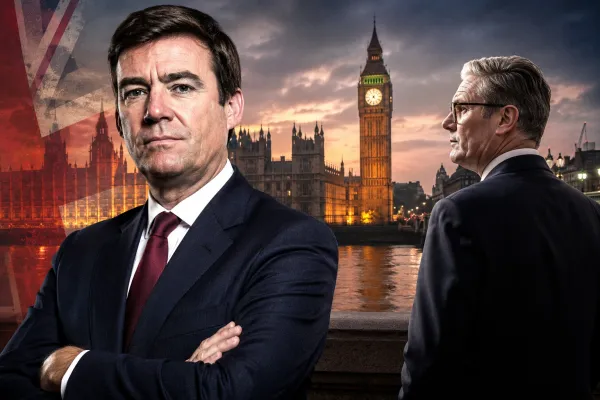
The British Political Earthquake Nobody in America Can Afford to Ignore: 5 Reasons Burnham Changes Everything
Most headlines focus on a by-election win. The bigger story is Andy Burnham's return to Parliament and what it could mean for Keir Starmer's future. As Labour's internal dynamics shift, Washington and investors are watching Britain's next political move closely.


Most Americans probably couldn't name the current British Prime Minister without thinking twice.
And under normal circumstances, a parliamentary by-election in a constituency outside Manchester would barely register in Washington or on Wall Street.
But this time feels different.
The recent by-election victory that returned Andy Burnham to Parliament is being viewed by many political observers as more than a local political event. Beneath the headlines lies a deeper story—one that raises uncomfortable questions about Prime Minister Keir Starmer's leadership and the future direction of the Labour Party.
From an American perspective, the significance is not simply that Burnham won a seat.
The real question is this:
Has Britain quietly entered the post-Starmer era before Starmer himself has left office?
The Bottom Line: Washington Is Beginning to Think Beyond Starmer
Politics is often about anticipating what comes next rather than focusing on what exists today.
That is especially true in foreign policy.
For U.S. policymakers, the issue is no longer whether Keir Starmer remains Prime Minister today. Instead, the growing conversation centers on how long his political authority can remain intact and who might eventually replace him.
This matters because Britain is not just another ally.
It remains America's closest strategic partner.
Whether the issue is intelligence sharing, NATO strategy, financial coordination, or global diplomacy, London and Washington continue to operate as key pillars of the Western alliance.
When political uncertainty emerges in Britain, it inevitably captures attention in the United States.
Why Washington Preferred Starmer
One of Starmer's greatest strengths from an American perspective has been predictability.
That may not excite voters, but it matters enormously in international affairs.
Since taking office, Starmer has largely maintained continuity on the major issues that matter most to Washington.
He has supported NATO commitments.
He has remained aligned on Ukraine.
He has avoided significant public disputes with the United States on Middle East policy.
In short, Starmer has been viewed as a stable and reliable partner.
For U.S. officials dealing with simultaneous crises involving China, Russia, the Middle East, and global economic uncertainty, stability is often more valuable than political charisma.
Yet stability alone does not always guarantee political survival.
And that is where Andy Burnham enters the picture.
Why Andy Burnham Matters
Many outside Britain still see Burnham primarily as a regional political figure.
That interpretation misses the larger story.
Burnham has spent years building a strong political identity among working-class voters in Northern England. As Mayor of Greater Manchester, he cultivated a reputation for challenging Westminster while presenting himself as a champion of local communities.
His appeal is not primarily ideological.
It is personal.
Voters often view him as authentic, approachable, and deeply connected to the regions that traditional Labour supporters call home.
For years, one obstacle prevented Burnham from becoming a serious contender for national leadership.
He was not a Member of Parliament.
Now he is.
That single change transforms the political landscape.
What was once a hypothetical leadership alternative has suddenly become a realistic one.
And in politics, potential rivals are far less dangerous than credible alternatives.
Starmer's Real Problem Isn't Failure
One of the most misunderstood aspects of British politics today is the assumption that Starmer's difficulties stem from poor governance.
That is not necessarily the case.
His government has been relatively disciplined.
His administration has largely avoided major scandals.
His leadership has projected competence.
The problem is something more subtle.
Many Labour supporters increasingly feel that the government lacks a compelling vision.
Winning power is one challenge.
Convincing voters that meaningful change is happening is another.
Within sections of Labour's traditional base, frustration appears to be growing.
The question being asked is simple:
"We won the election. Why doesn't it feel like the country is changing?"
That sentiment, more than any individual policy dispute, may explain why figures like Burnham are attracting renewed attention.
Wall Street Cares About Something Else Entirely
Political commentators tend to focus on personalities.
Financial markets focus on uncertainty.
That distinction is important.
Investors are not necessarily concerned about whether Burnham becomes Labour leader.
What concerns them is the possibility that Britain's policy direction could become less predictable.
If Labour enters a prolonged leadership struggle, markets will begin asking questions such as:
- Will fiscal policy change?
- Will government spending increase?
- Will business taxation rise?
- Will industrial policy become more interventionist?
- Will infrastructure investment expand significantly?
Political transitions often create periods of uncertainty, and uncertainty is something markets consistently dislike.
This is why a British by-election can quickly become relevant far beyond Britain's borders.
The International Context Makes This More Significant
The timing of these developments matters.
The world is not experiencing a period of geopolitical calm.
The Middle East remains volatile.
Competition between the United States and China continues to intensify.
The global economy faces questions surrounding growth, debt, and technological disruption.
In such an environment, Washington values dependable allies.
A politically distracted Britain is not necessarily a weaker ally, but it is a more complicated one.
If Labour becomes consumed by internal leadership tensions, Britain's ability to project political consistency abroad may diminish.
That possibility is one reason American policymakers are paying closer attention than many observers realize.
What Many People Are Missing
A by-election does not change a country overnight.
History rarely works that way.
Major political shifts usually begin with small signals that seem insignificant at the time.
Most people focus on events.
Strategists focus on trends.
Investors focus on future probabilities.
The significance of Burnham's return is not the parliamentary seat itself.
It is what the victory may represent.
For the first time in years, Labour now has a plausible alternative figure capable of commanding national attention, energizing parts of the party base, and potentially challenging the existing leadership structure.
Whether that challenge ultimately materializes remains uncertain.
But the possibility alone changes the conversation.
The Question That Now Matters Most
Many observers are asking whether Andy Burnham will become Britain's next Prime Minister.
The honest answer is that nobody knows.
Politics is rarely that predictable.
But there is a more important question emerging beneath the surface:
What does the future of Labour look like after Keir Starmer?
The fact that this question is now being asked by political insiders, investors, and international observers alike may be the most significant development of all.
Because once political systems begin debating the future beyond a sitting leader, the transition has often already begun.
Frequently Asked Questions (FAQ)
Q1. Why is Andy Burnham's return to Parliament important?
Andy Burnham's return removes the biggest obstacle that previously limited his national political ambitions. As an MP again, he is now positioned to play a significant role in Labour Party leadership discussions and potentially future leadership contests.
Q2. Is Keir Starmer likely to be replaced as Labour leader?
There is currently no formal leadership challenge. However, growing dissatisfaction within parts of the Labour Party has increased speculation about alternative leadership figures, with Burnham frequently mentioned among them.
Q3. Why are U.S. policymakers interested in British politics?
The United Kingdom remains America's closest strategic ally. Any major political shift in Britain can influence NATO cooperation, foreign policy coordination, intelligence sharing, and economic relations.
Q4. How could a leadership change affect financial markets?
Investors closely monitor potential changes in taxation, government spending, industrial policy, and regulation. Political uncertainty often creates market volatility as investors reassess future economic policies.
Q5. What makes Andy Burnham different from Keir Starmer?
Burnham is often associated with Labour's traditional working-class base and regional politics, while Starmer is viewed as a more centrist and technocratic leader. Their political styles appeal to different segments of the Labour electorate.
Q6. Could Andy Burnham become the next Prime Minister?
It is possible but far from certain. Any path to becoming Prime Minister would likely require first securing leadership of the Labour Party and maintaining broad support among MPs and voters.
Q7. Why does this by-election matter beyond the UK?
The result is being interpreted by some analysts as a signal of shifting political dynamics inside Labour. Because Britain plays a major role in global finance and international security, leadership changes attract attention from investors and policymakers worldwide.
Final Thoughts
Let's return to the central point.
Andy Burnham's parliamentary comeback is not merely a local political story.
From Washington's perspective, it may be an early signal of a broader shift within British politics.
The concern is not simply who occupies Downing Street today.
The concern is who might occupy it tomorrow—and what that change could mean for Britain's domestic priorities, economic policies, and strategic relationship with the United States.
For now, Keir Starmer remains firmly in office.
But politics has a habit of changing long before official announcements are made.
And across both London and Washington, more people are beginning to ask a question that would have seemed unlikely only months ago:
Has Britain's next political chapter already begun?