Claude Fable 5: A Bigger Shift Than ChatGPT—AI Is Finally Getting Real Work Done
Claude Fable 5 isn't just another AI chatbot. It's one of the first truly autonomous AI systems designed to plan, execute, and improve complex tasks over time. Here's why this shift may matter more than raw intelligence.

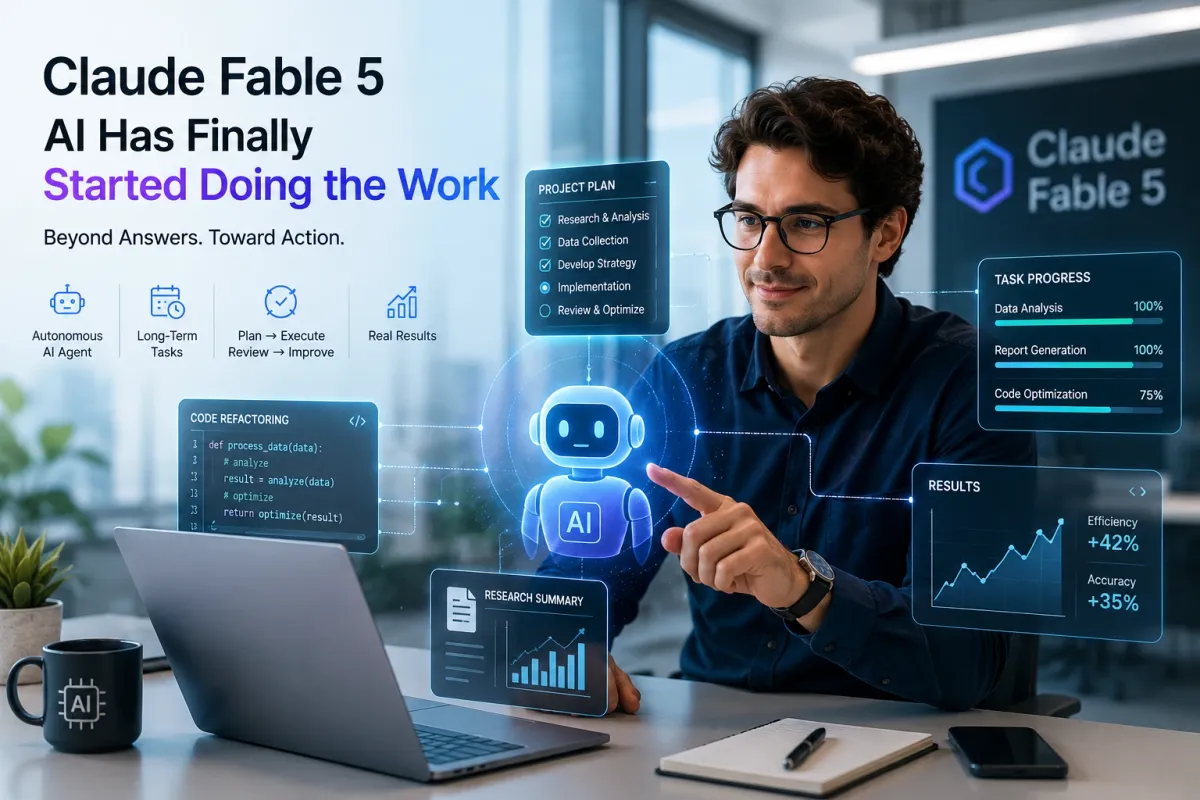
Have you ever had this thought while using AI?
"It's great at answering questions, but I still have to guide it every step of the way."
That's been true for most AI systems so far.
They've been incredibly capable assistants, but assistants nonetheless. They wait for instructions, execute tasks, and then wait for the next command.
But Anthropic's Claude Fable 5 appears to be moving in a different direction.
Instead of simply responding to prompts, it is designed to handle long-running, goal-oriented tasks with a level of autonomy we've rarely seen before.
And that could change how we think about AI entirely.
The Bottom Line: Claude Fable 5 Is About Working, Not Just Thinking
Most people evaluate AI models based on benchmarks and performance scores.
While those metrics matter, they're not the most interesting thing about Claude Fable 5.
Its defining feature is long-term autonomy.
Traditional AI models excel at completing individual tasks. Give them a prompt, and they produce an answer.
Claude Fable 5 aims to do something more ambitious.
It can take a complex objective and break it down into multiple stages, planning and executing the work while continuously refining its approach.
Think about tasks such as:
- Large-scale codebase migrations
- Software architecture refactoring
- Multi-step research projects
- Long-term project management
- Complex knowledge work
Rather than stopping after a single response, the model can move through a cycle of:
Plan → Execute → Review → Improve
This is where it begins to feel less like a chatbot and more like a digital collaborator.
The Misconception Most People Have About AI
When people hear that a new AI model is more powerful, they often assume it simply generates better answers.
But in real-world work environments, that's not always the biggest challenge.
The real challenge is getting the work finished.
At one point, I found myself wondering:
"What if intelligence isn't the most valuable feature anymore? What if completion is?"
Claude Fable 5 seems designed around that exact idea.
Instead of focusing solely on solving individual problems, it focuses on connecting dozens of tasks together and driving them toward a final outcome.
That's a fundamentally different approach.
Why Developers Are Paying Attention
One pattern becomes obvious when looking at software engineering use cases.
Most AI systems can write snippets of code.
That's no longer impressive.
Real software development involves:
- Understanding massive codebases
- Tracking down obscure bugs
- Maintaining architectural consistency
- Modernizing legacy systems
These are challenges that require context, persistence, and careful reasoning over time.
Claude Fable 5 appears particularly strong in areas such as:
- Debugging
- Refactoring
- Architecture optimization
- Legacy code modernization
In many ways, it moves beyond code generation and closer to becoming an engineering partner.
And that's a significant shift.
Vision Capabilities Have Also Taken a Major Leap Forward
Text understanding is no longer enough.
Modern business workflows are filled with visual information.
Claude Fable 5 reportedly improves its ability to analyze and interpret:
- Technical documentation
- System diagrams
- Complex screenshots
- Data visualizations
- Dashboards and reports
For organizations dealing with large amounts of mixed media content, this capability could become increasingly valuable.
Claude Fable 5 vs. Claude Mythos 5: What's the Difference?
This is where many people get confused.
The short answer is that both models are built on the same underlying Mythos-class foundation model.
However, they are intended for different audiences.
Claude Fable 5
- Available to the general public
- Enterprise-ready deployment
- Accessible through API, web, and mobile platforms
- Includes full safety protections
Claude Mythos 5
- Reserved for verified partners and researchers
- Certain restrictions are relaxed
- Optimized for cybersecurity and specialized research environments
- Intended for advanced professional use cases
A simple analogy might help.
Claude Fable 5 is like a high-performance sports car built for public roads.
Claude Mythos 5 is more like a race car designed for controlled professional environments.
Safety Remains a Core Design Principle
One of the most notable aspects of Claude Fable 5 is Anthropic's emphasis on safety.
The model reportedly includes safeguards against requests involving:
- Cyberattack development
- Biological risk information
- Chemical hazard scenarios
- AI model replication and distillation
What's particularly interesting is the user experience design.
Rather than simply blocking certain requests, the system may automatically transition those interactions to Claude Opus 4.8, helping maintain workflow continuity.
For enterprise users, that kind of seamless handling could be just as important as raw model performance.
What About Pricing?
Claude Fable 5 is reportedly priced at:
- $10 per million input tokens
- $50 per million output tokens
At first glance, that may not seem inexpensive.
But focusing solely on token pricing misses the bigger picture.
The real question is:
How much time does it save?
If an AI system can reduce hours—or even days—of manual effort, productivity gains can easily outweigh token costs.
For complex projects, efficiency often matters more than the price of computation itself.
A Glimpse Into the Future of AI
Here's an interesting question.
What do you actually want from AI?
A smarter chatbot?
Or a digital teammate that can independently move projects forward?
I believe the competitive landscape of AI is gradually shifting.
The future may not belong to the model that produces the most impressive answers.
It may belong to the model that can sustain productive work over extended periods without constant supervision.
Claude Fable 5 appears to be one of the clearest examples of that transition.
Take a moment to think about it.
Do you need more information?
Or do you need a system capable of turning information into completed work?
That's where the conversation is heading.
Frequently Asked Questions (FAQ)
Q1. What is Claude Fable 5?
Claude Fable 5 is a next-generation AI model designed to perform long-running, goal-oriented tasks with a high degree of autonomy. Instead of only answering prompts, it can plan, execute, review, and refine complex workflows.
Q2. How is Claude Fable 5 different from ChatGPT?
The key difference is autonomy. While traditional AI systems focus on responding to individual prompts, Claude Fable 5 is designed to handle multi-step projects and continue working toward a larger objective with minimal supervision.
Q3. Is Claude Fable 5 good for coding?
Yes. Claude Fable 5 is particularly strong in software engineering tasks such as debugging, refactoring, architecture analysis, and large-scale codebase maintenance.
Q4. What is the difference between Claude Fable 5 and Claude Mythos 5?
Both reportedly share the same Mythos-level foundation model. However, Claude Fable 5 is intended for public and enterprise use with full safety protections, while Claude Mythos 5 is designed for verified research and specialized environments.
Q5. Can Claude Fable 5 analyze images and documents?
Yes. The model includes advanced vision capabilities that allow it to interpret technical documents, dashboards, screenshots, diagrams, charts, and other visual content.
Q6. Is Claude Fable 5 safe to use?
According to the provided specifications, Claude Fable 5 includes safeguards against cyberattack generation, biological risks, chemical hazards, and AI model replication activities.
Q7. What industries can benefit most from Claude Fable 5?
Software development, research, consulting, project management, data analysis, enterprise operations, and knowledge-intensive professions are expected to benefit the most.
Q8. Is autonomous AI the future?
Many experts believe the next stage of AI development will focus less on generating answers and more on independently completing meaningful work. Autonomous AI systems represent a major step in that direction.
Final Thoughts
The most important thing to understand about Claude Fable 5 is this:
Its biggest advancement isn't intelligence—it's autonomy.
The AI industry is moving beyond systems that simply answer questions.
We're entering an era where AI can receive objectives, create plans, execute tasks, and refine its own work over time.
If you're looking for an AI that functions as more than a search tool or conversational assistant, Claude Fable 5 is certainly worth watching.
The remaining question is simple.
Are you still asking AI for answers?
Or are you ready to start assigning it work?