I Lost My YouTube Channel. These 3 Technologies Are Protecting My Future in 2026.
After losing my YouTube channel, I learned a painful truth: creators don't own their audiences. This guide explains why I chose Ghost CMS, how I built twicetidetime.com, and the three technologies every creator needs to survive platform risk in 2026.

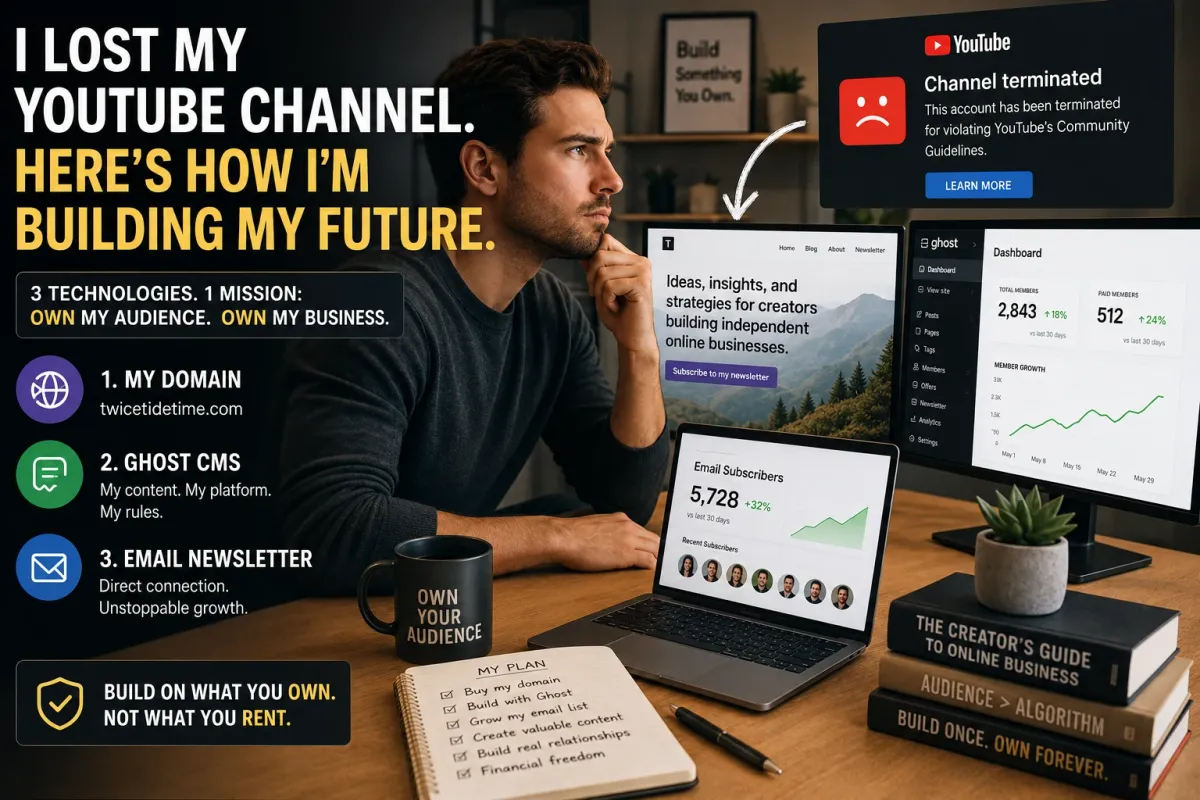
Why I'm Building Everything Around twicetidetime.com
Twenty days ago, YouTube terminated my channel.
No warning.
No meaningful explanation.
No response to my appeal.
Just like that, years of work disappeared.
At first, I thought my biggest problem was losing my channel.
I was wrong.
The real problem was realizing I had spent years building on land I didn't own.
That realization changed everything.
Today, I'm rebuilding around something YouTube can't take away:
my own domain, my own website, and my own audience.
Specifically:
twicetidetime.com
This article isn't about why I lost my channel.
It's about what I'm doing next.
And if you're a creator, blogger, coach, or online entrepreneur, it might be the most important shift you make in 2026.
Conclusion First: Stop Building Your Business Inside Platforms
Let me save you years of trial and error.
The future belongs to creators who own their audience.
Not creators with the most subscribers.
Not creators with the biggest social media following.
Not creators who master the algorithm.
The winners will be the people who own:
- Their domain
- Their website
- Their email list
- Their customer relationships
Everything else is rented land.
I learned this lesson the expensive way.
Technology #1: Your Domain Is Your Digital Home
The first thing I committed to protecting was my domain.
twicetidetime.com
Most creators treat a domain as a technical detail.
I now see it as the most valuable asset in my entire business.
Think about it.
Your YouTube channel can disappear.
Your Instagram account can be suspended.
Your TikTok reach can vanish overnight.
But your domain remains yours.
As long as you renew it, nobody controls your relationship with your audience.
That's why every creator should secure their domain before worrying about content strategy.
The domain is the foundation.
Everything else sits on top of it.
Technology #2: Why I Chose Ghost Instead of WordPress
This decision surprised even me.
For years, I assumed WordPress was the obvious choice.
After researching modern creator businesses, I changed my mind.
I chose Ghost.
Here's why.
Ghost Is Built for Audience Ownership
Most websites focus on publishing content.
Ghost focuses on building audiences.
That's a critical difference.
Ghost includes:
- Native newsletters
- Member subscriptions
- Email automation
- Premium content
- Creator memberships
Without installing dozens of plugins.
The platform is designed around one question:
How do you turn visitors into subscribers?
That's exactly what I need now.
Because subscribers are assets.
Traffic is not.
Simplicity Matters
One thing I learned after losing YouTube:
Complex systems create fragile businesses.
Ghost is refreshingly simple.
No plugin conflicts.
No endless updates.
No bloated dashboard.
No constant maintenance headaches.
The less time I spend fixing technology, the more time I spend creating content.
And that's the entire point.
Technology #3: Building an Email List From Day One
This is where most creators make their biggest mistake.
I know because I made it too.
I focused on subscribers.
I should have focused on subscribers' email addresses.
Huge difference.
When YouTube removed my channel, I couldn't contact my audience.
That was the real loss.
An email list changes everything.
With an email list, you can:
- Launch a new channel
- Announce a new website
- Sell products
- Build memberships
- Generate traffic on demand
Without asking permission from an algorithm.
Email remains the most underrated creator asset in 2026.
Not because it's new.
Because it still works.
My Current Ghost Setup
I'm intentionally keeping things simple.
Here's the structure I'm building around twicetidetime.com.
Core Website
Homepage
About Page
Blog
Contact Page
Newsletter Signup
Nothing complicated.
No fancy features.
Just a strong foundation.
Content Strategy
Every article serves one purpose:
Convert anonymous visitors into subscribers.
Not pageviews.
Not vanity metrics.
Subscribers.
Because subscribers become readers.
Readers become customers.
Customers become a business.
Newsletter Strategy
Weekly email.
Direct communication.
No algorithm.
No platform dependency.
No middleman.
Just me and the people who want to hear from me.
That's the relationship I should have built years ago.
The Biggest Mindset Shift
This is what changed everything for me.
I stopped thinking like a YouTuber.
I started thinking like a media company.
Media companies don't rely on one platform.
They own distribution.
They own audiences.
They own customer relationships.
Creators who survive the next decade will think the same way.
The Creator Survival Checklist for 2026
If you're reading this today, here's what I recommend.
Step 1
Buy your domain.
Today.
Not next month.
Today.
Step 2
Build a website you control.
Ghost is my choice.
Your choice may be different.
But own your platform.
Step 3
Start collecting email subscribers immediately.
Even if you only have ten.
Start now.
Step 4
Treat social media as traffic.
Not as your business.
Step 5
Create content that points people back to assets you own.
Every time.
Without exception.
FREQUENTLY ASKED QUESTIONS
Q1. Why did you choose Ghost instead of WordPress?
Ghost is designed for audience ownership. It includes newsletters, memberships, subscriptions, and email marketing without relying on dozens of plugins. For creators focused on building a direct audience, Ghost offers a cleaner and simpler solution.
Q2. What is the biggest lesson from losing a YouTube channel?
The biggest lesson is that subscribers on a platform are not truly your audience. If you cannot contact them without the platform, you do not own the relationship.
Q3. Why is a personal domain more important than a social media account?
A domain belongs to you. Social media accounts operate under platform rules and can be restricted, suspended, or removed at any time.
Q4. What is audience ownership?
Audience ownership means having a direct communication channel with your followers through assets you control, such as email lists, memberships, and websites.
Q5. Is Ghost CMS good for SEO?
Yes. Ghost provides clean code, fast loading speeds, built-in structured data, automatic XML sitemaps, and strong technical SEO foundations.
Q6. Can Ghost replace Substack?
For many creators, yes. Ghost offers newsletter functionality similar to Substack while providing complete control over branding, monetization, and website ownership.
Q7. What should creators build first?
Most creators should start with:
• A domain name
• A website
• An email newsletter
These three assets form the foundation of an independent creator business.
Q8. How does an email list protect creators?
An email list allows direct communication with subscribers regardless of platform changes, algorithm updates, or account suspensions.
Q9. What technologies are essential for creator independence in 2026?
The three most important technologies are:
• A personal domain
• A creator-owned website (Ghost CMS)
• An email marketing system
Q10. What is the long-term goal of a creator-owned platform?
The goal is to build a sustainable business that survives beyond any single platform, algorithm, or social media network.
Final Thoughts
Losing my YouTube channel felt like losing everything.
For a while, I believed it.
Now I see things differently.
The channel was never the business.
The audience relationship was.
The platform was never the asset.
Ownership was.
That's why I'm rebuilding around twicetidetime.com.
Not because I expect another platform ban.
But because I never want my future controlled by a platform again.
If you're a creator reading this, learn from my mistake.
Build where you have permission.
Grow where you have ownership.
And protect what no algorithm can take away.