Was It 500 Meters or 150? What the Russian Warship Warning-Shot Incident Really Teaches Us
A Russian warship fired warning shots near a British yacht. But the real story isn't who was right or wrong—it's how conflicting facts, disputed distances, and competing narratives shape the way we interpret international news.

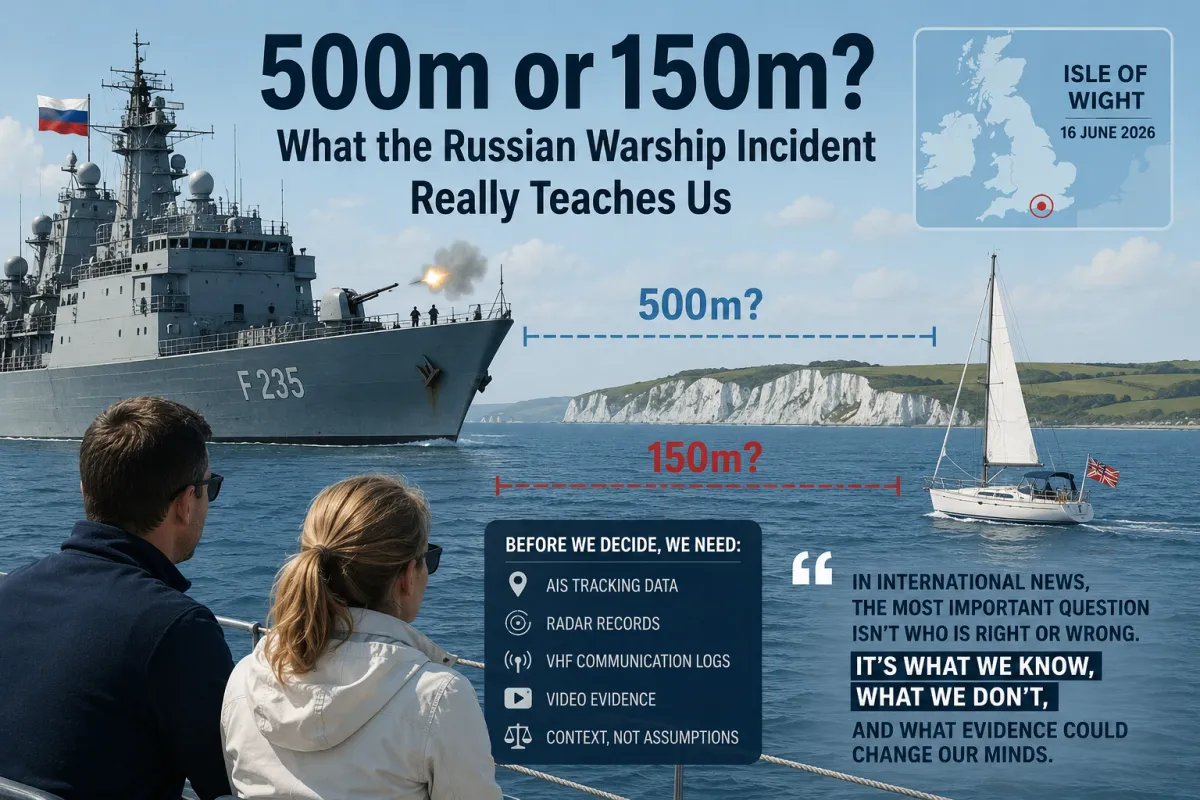
There are moments when international news becomes strangely dangerous.
Not when there are no facts at all.
Ironically, it is often when only a few facts are available that people become most confident in their conclusions.
The recent warning-shot incident involving a Russian warship and a British yacht south of the Isle of Wight is a perfect example.
At first glance, the headline seems to tell the whole story.
"Russian warship fires warning shots near British yacht."
It is dramatic.
It sounds serious.
But how much do we actually know?
A question kept coming to mind as I followed the coverage:
What if we are consuming interpretations before we understand the event itself?
The Real Story Isn't About Russia
Let me start with the conclusion.
The most important lesson from this incident is not whether Russia was right or wrong.
It is how we deal with uncertainty.
Many people immediately ask:
"So who is at fault?"
That is a natural question.
But there is a more important one:
What do we actually know, and what do we only think we know?
This incident is almost a textbook case of how international news should be read.
Because confirmed facts, competing claims, and political interpretations have all been mixed together from the very beginning.
The List of Confirmed Facts Is Surprisingly Short
At this stage, the following points appear relatively well established:
- The incident occurred on June 16, 2026.
- It took place south of the Isle of Wight.
- A Russian warship and a British-registered civilian yacht encountered each other at close range.
- The Russian vessel fired warning shots.
- The yacht was carrying a British couple.
- No one was injured.
- The yacht suffered no damage.
- The British government described the action as reckless and concerning.
So far, so good.
The real controversy begins after that.
Why 500 Meters and 150 Meters Tell Completely Different Stories
The most important number in this incident is not the number of shots fired.
It is the distance.
Some reports suggest the yacht was approximately 500 yards away—roughly 450 meters—when the warning shots were fired.
Russia tells a different story.
According to Russian officials, the yacht approached to within 150 meters, ignored radio calls, signal flares, and sound warnings, and therefore prompted a warning shot to prevent a potential collision.
Many readers glance over these numbers.
But at sea, they matter enormously.
A distance of 450 meters and a distance of 150 meters describe two very different situations.
At 450 meters, the warning shots may appear excessive.
At 150 meters, a large naval vessel could plausibly argue that collision concerns were becoming serious.
This is where many people make a mistake.
They assume one side must be lying.
Reality is often more complicated.
What If Both Distances Are Correct?
This possibility deserves more attention.
The reported 500-meter figure may refer to the distance at the moment warning shots were fired.
The 150-meter figure may refer to the closest point of approach earlier or later in the encounter.
In other words, both sides could be describing different moments within the same event.
Numbers often look objective.
But numbers without context can be misleading.
When was the distance measured?
Between which objects?
At the time of firing?
At the point of closest approach?
Without answers to those questions, a number becomes less of a fact and more of an impression.
In International News, Narratives Often Move Faster Than Facts
Think about the words attached to this story:
Russia.
Britain.
Warship.
Civilian yacht.
Warning shots.
NATO.
English Channel.
The moment these terms appear together, people begin constructing narratives.
Some see Russian aggression.
Others see a maritime safety incident.
Some interpret the event as a political signal to Britain.
Others view it as a procedural response to a navigation risk.
All of these interpretations are possible.
But possible is not the same as proven.
One of the most common mistakes in international affairs is treating a plausible explanation as if it were an established fact.
This tendency becomes even stronger when people already have firm views about a country or government involved in the story.
Past behavior matters.
Context matters.
But context is not evidence.
It can increase the probability of a particular interpretation.
It cannot replace proof.
The Best Question Is Not "Who Is the Villain?"
Whenever an incident occurs, people instinctively look for someone to blame.
That is understandable.
But international events often require a different approach.
After years of watching geopolitical disputes unfold, I have noticed that the most useful question is usually this:
What evidence would make me change my mind?
Everything looks different once you ask that question.
For example:
- What if AIS tracking data becomes available?
- What if radar records are released?
- What if VHF radio logs are published?
- What if the exact direction of the warning shots is verified?
Would those pieces of evidence strengthen your current view?
Or force you to revise it?
Without asking this question, we are not really evaluating evidence.
We are simply searching for confirmation of what we already believe.
Suspending Judgment Is Not Weakness
Many people misunderstand this point.
They assume that withholding judgment means avoiding responsibility.
It does not.
In reality, the opposite is true.
The purpose of caution is to make accountability more accurate.
If conclusions are drawn too quickly, they become vulnerable.
The moment new facts emerge, the entire argument can collapse.
That is why the strongest criticisms are often the most careful.
Caution is not weakness.
It is what allows a judgment to survive scrutiny over time.
Three Rules for Reading International News
This incident leaves behind three useful principles.
1. Separate Events from Interpretations
"Warning shots were fired."
That is an event.
"Russia was sending a political message."
That is an interpretation.
Both statements may appear in the same article.
They are not the same kind of claim.
2. Always Ask What a Number Actually Measures
500 meters.
150 meters.
Both are numbers.
But their meaning depends entirely on what moment and what reference point they describe.
Numbers are objective.
Their interpretation often is not.
3. Decide in Advance What Evidence Could Change Your View
Pause for a moment.
What do you need more right now?
More information?
Or better standards for evaluating information?
The most dangerous mindset is not a lack of knowledge.
It is a refusal to reconsider a belief regardless of what evidence appears.
The Real Lesson Is Not the Incident—It Is the Way We Think
To be honest, this story will probably disappear from the headlines soon.
No one was injured.
No vessel was damaged.
The encounter did not escalate into a military confrontation.
As a news story, its lifespan may be short.
As a lesson in critical thinking, however, it may last much longer.
Because almost every challenge of modern international reporting is present here.
Few confirmed facts.
Conflicting accounts.
Numbers without clear context.
Strong political implications.
Limited objective evidence.
And an audience eager to fit the story into an existing narrative.
That is why the central issue is not a Russian warship.
The central issue is how we process uncertainty.
Can we separate:
- Confirmed facts
- Claims made by the parties involved
- Government statements
- Media framing
- Our own interpretations
The better we become at making those distinctions, the safer our judgments become.
And the longer those judgments are likely to hold up.
In the end, the most important question is not simply:
"What was Russia's intention?"
That question matters.
But there is an even more important one.
What do we know, what do we not know, and what evidence would make us reconsider our conclusions?
That question is not just about this incident.
It is about how we understand the world.
Frequently Asked Questions (FAQ)
1. What happened between the Russian warship and the British yacht?
A Russian naval vessel reportedly fired warning shots near a British-registered civilian yacht south of the Isle of Wight on June 16, 2026. No injuries or damage were reported, but both sides provided different accounts of the encounter.
2. Why is the distance between the vessels controversial?
Some reports suggest the yacht was approximately 500 yards (about 450 meters) away during the warning shots, while Russian officials claim it approached within 150 meters. The difference significantly affects how the incident is interpreted.
3. Did the Russian warship attempt to contact the yacht before firing?
Russian authorities claim radio calls, signal flares, and sound warnings were issued before the warning shots. Independent verification of these claims has not yet been publicly confirmed.
4. Was the yacht actually on a collision course?
At the time of reporting, publicly available evidence was insufficient to definitively determine whether a collision risk existed. AIS tracking data, radar records, and navigation logs would provide stronger evidence.
5. Why is this incident important beyond the immediate event?
The case demonstrates how international news often develops before all facts are available. It highlights the importance of distinguishing between confirmed facts, official statements, media framing, and personal interpretation.
6. What evidence would help clarify what really happened?
The most useful evidence would include:
- AIS vessel tracking records
- Radar data
- VHF radio communication logs
- Video recordings
- Details regarding the direction and purpose of the warning shots
7. What is the biggest lesson from this incident?
The key lesson is that international events should be evaluated through evidence rather than assumptions. Understanding what is known, what remains uncertain, and what evidence could change our conclusions is often more important than reaching an immediate judgment.