Sell Your Rental Property Now? 6 Brutally Honest Rules That Make the Decision for You
Most investors are told to never sell real estate. That's bad advice. Learn the six decision-making rules that separate successful investors from emotional investors—and discover when selling a rental property can actually accelerate your wealth.


"Never sell real estate."
If you've spent any time around investors, you've probably heard that advice more times than you can count.
And honestly?
There's a lot of truth to it.
Some of the wealthiest real estate investors in America built their fortunes simply by buying great properties and holding them for decades.
But here's the part nobody talks about:
Sometimes selling is exactly the right move.
Not because the market is crashing.
Not because you're giving up.
And certainly not because you've failed.
Sometimes the smartest thing you can do is let a property go.
The real challenge is knowing the difference between a property you should keep forever and one that's quietly holding your portfolio back.
After years of investing, I've noticed that most successful investors eventually stop asking:
"Should I sell?"
And start asking:
"Does this property still deserve a spot in my portfolio?"
That's a completely different question.
Reason #1: The Property Has Become a Full-Time Job
Let's start with the obvious one.
Every investor owns a property at some point that simply isn't worth the headache.
On paper, the numbers look fine.
In reality?
It's constant stress.
The tenants complain.
The neighbors complain.
The maintenance requests never stop.
Every time your phone rings, your stomach drops a little.
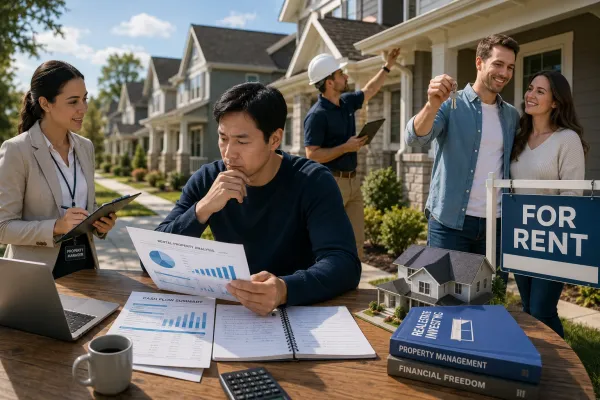
I think one of the biggest mistakes investors make is focusing only on ROI.
Return on investment matters.
But there's another metric that's just as important:
Return on Brain Damage
How much mental energy are you spending to earn that income?
I've seen properties generate decent cash flow while simultaneously draining every ounce of an owner's patience.
And eventually you have to ask yourself:
Is this property making my life better?
Or is it simply creating another job?
Early in your investing career, you might tolerate more chaos because you're focused on growth.
But eventually, peace of mind becomes valuable too.
A property that constantly creates stress may not be a good investment—even if the cash flow looks decent on paper.
Reason #2: There's a Better Opportunity Waiting
This is where things get interesting.
Most investors become emotionally attached to properties.
The problem is that equity doesn't care about your emotions.
Let's say you own a rental that generates $20,000 per year in cash flow.
Not bad.
But after several years of appreciation, you discover you could sell and walk away with $400,000 in equity.
Now the question changes.
Would you rather:
- Collect $20,000 per year for the next couple decades?
- Or take $400,000 today and put it to work somewhere else?
For many investors, that second option becomes extremely attractive.
Especially if they can redeploy that capital into:
- A larger property
- A stronger market
- A value-add project
- Multiple new investments
The goal isn't selling.
The goal is upgrading.
That's an important distinction.
Selling a mediocre property to buy another mediocre property doesn't accomplish much.
But selling a good property to acquire a great one?
That's often how portfolios evolve.
That said, this is where many investors make costly mistakes.
A better opportunity must actually be better.
Buying a replacement property simply to avoid taxes or because you're in a hurry often creates more problems than it solves.
Reason #3: You're No Longer Building—You're Harvesting
This is the phase nobody talks about enough.
Most investing content focuses on growth.
Buy more.
Scale bigger.
Acquire faster.
Add doors.
Increase units.
Build wealth.
And that's fine.
But eventually, every investor reaches a point where they start asking a different question:
How much is enough?
That's when the game changes.
You're no longer trying to maximize growth.
You're trying to maximize freedom.
The objective shifts from accumulation to preservation.
I've watched many investors sell portions of their portfolios not because they needed money, but because they wanted simplicity.
They wanted fewer properties.
Less debt.
Less risk.
More time.
More flexibility.
And frankly, more peace.
Some use the proceeds to pay off rental loans.
Others eliminate their primary residence mortgage.
Some simply increase their cash reserves.
The common theme is the same:
They're reducing risk.
That's not quitting.
It's maturity.
Growing wealth requires offense.
Protecting wealth requires defense.
At some point, every successful investor has to learn both.
Three Reasons You Should Think Twice Before Selling
Now let's talk about the other side of the equation.
Because selling isn't always the answer.
In fact, there are times when selling can be one of the biggest mistakes you'll ever make.
1. It's One of Your Best Properties
This is probably the biggest one.
Good properties attract buyers.
Great properties attract everyone.
If a property consistently produces strong cash flow, requires minimal management, sits in a desirable location, and has long-term demand, why would you sell it?
Many experienced investors rank every property they own.
When it's time to prune the portfolio, they sell from the bottom of the list—not the top.
The problem is that investors often receive unsolicited offers on their best assets.
The offer sounds exciting.
The number looks attractive.
The imagination starts running wild.
But before accepting, ask yourself:
If I sold this today, could I realistically replace it with something equally good?
In many cases, the answer is no.
And that's exactly why it should stay in your portfolio.
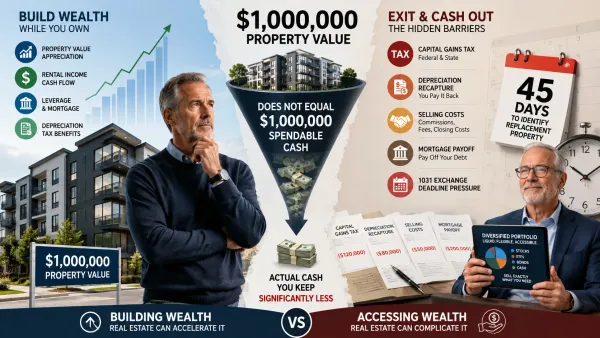
2. You Haven't Calculated the Tax Consequences
This is where excitement can become expensive.
Many investors focus on the sale price.
Very few focus on what actually ends up in their bank account.
Capital gains taxes.
Depreciation recapture.
State taxes.
Transaction costs.
These can dramatically reduce the proceeds from a sale.
I've seen investors get excited about six-figure gains only to discover their tax bill was much larger than expected.
That's not a reason to avoid selling.
It's a reason to plan properly.
Before you list any property, sit down with a CPA and understand the full picture.
Not the gross profit.
The net profit.
There's a huge difference.
3. You're Letting Headlines Make the Decision
Turn on the news any day of the year and you'll find a reason to panic.
Interest rates.
Inflation.
Politics.
Recessions.
Housing crashes.
Economic uncertainty.
There's always something.
The problem is that real estate is a long-term business.
The news operates on a 24-hour cycle.
Those two timelines rarely align.
Some of the worst investment decisions happen when investors react emotionally to short-term events.
They sell because they're scared.
Then five years later, they wish they hadn't.
The best investors I've studied share one common trait:
They make decisions based on fundamentals, not headlines.
A strong property doesn't suddenly become a bad property because the news cycle changed.
If anything, periods of uncertainty often create the best opportunities.
Frequently Asked Questions
1. When should I sell a rental property?
You should consider selling when the property creates more stress than value, when a significantly better investment opportunity exists, or when you're intentionally reducing risk and simplifying your portfolio.
2. Is it better to keep a rental property forever?
Not always. While long-term ownership can build substantial wealth, some properties eventually become inefficient, high-maintenance, or less productive compared to alternative investments.
3. How do I know if my rental property is worth keeping?
Evaluate cash flow, appreciation potential, maintenance requirements, tenant quality, location strength, and overall return on investment. The best properties usually deserve a long-term place in your portfolio.
4. What is a 1031 exchange?
A 1031 exchange allows investors to defer capital gains taxes by selling an investment property and reinvesting the proceeds into another qualifying investment property under IRS guidelines.
5. Should taxes stop me from selling a property?
Taxes should influence your decision but not control it. Always calculate your after-tax profit and consult a CPA before selling, but don't let tax concerns alone prevent a strategically sound move.
6. What is the biggest mistake investors make when selling?
Many investors sell based on fear, market headlines, or short-term economic uncertainty rather than focusing on the property's long-term fundamentals and performance.
7. How does cash flow affect the decision to sell?
Strong and predictable cash flow is often a reason to hold. However, if the equity trapped in the property can generate significantly higher returns elsewhere, selling may be justified.
8. Should I pay off my primary residence before buying more rentals?
This depends on your risk tolerance and financial goals. Many experienced investors eventually prioritize reducing debt and increasing financial security over maximizing portfolio growth.
9. Can selling a property improve my portfolio?
Yes. Strategic portfolio pruning allows investors to eliminate underperforming assets and redeploy capital into stronger opportunities with better long-term potential.
10. What is the "Return on Brain Damage" concept?
Return on Brain Damage (ROD) measures how much stress, time, and mental energy a property requires relative to the income it generates. A property with high cash flow but constant problems may not be worth keeping.
The Bottom Line
If you're wondering whether you should sell a rental property, here's the simplest framework I know.
Sell when:
✔ The property creates more stress than value
✔ A significantly better opportunity exists
✔ You're intentionally reducing risk and entering a harvesting phase
Hold when:
✔ The property is one of the strongest assets you own
✔ You haven't fully analyzed the tax impact
✔ Fear and market noise are driving the decision
At the end of the day, successful investors don't fall in love with properties.
They fall in love with outcomes.
Sometimes that means holding a property for another twenty years.
Sometimes it means selling tomorrow.
The key is understanding which situation you're actually in.
And once you're honest about that answer, the decision usually becomes much easier.