I Lost My YouTube Channel in 20 Days: The 3 Assets Every Creator Must Own Before It's Too Late
Twenty days after losing my YouTube channel, I realized a painful truth: I never owned my business. Here's why every creator should build an audience, website, and newsletter they actually control before a platform takes everything away.

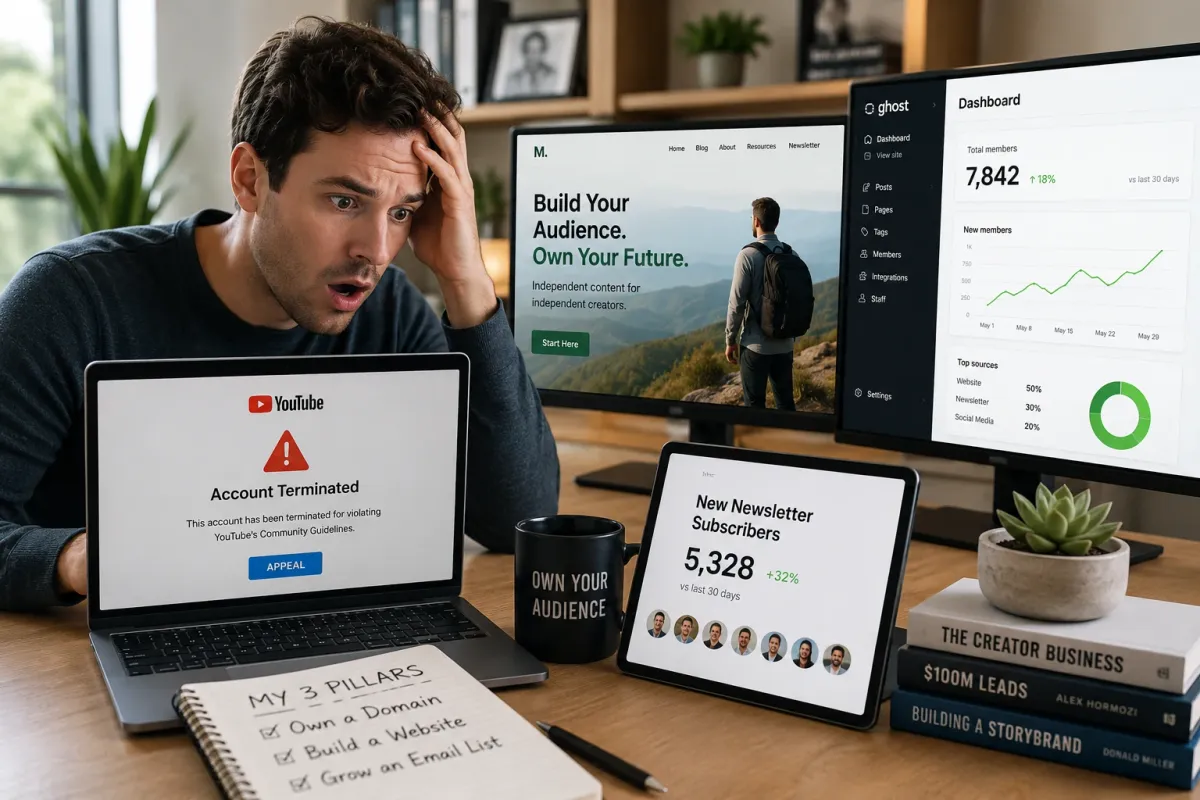
Twenty days ago, my YouTube channel was terminated.
The reason?
"Misrepresentation."
That was it.
No clear explanation.
No meaningful response to my appeal.
No opportunity to fix whatever YouTube believed I had done wrong.
Just like that, years of work disappeared overnight.
My videos.
My audience.
My income.
Gone.
For the first few days, I couldn't think about strategy.
I wasn't thinking about content.
I wasn't thinking about business.
I was asking myself a much simpler question:
"How am I supposed to survive this?"
YouTube wasn't just a platform for me.
It was my livelihood.
And when it disappeared, it felt like my entire life collapsed with it.
But after the shock began to fade, I realized something even more frightening.
The real problem wasn't that my channel was deleted.
The real problem was that I had built a business on land I didn't own.
The Lesson Cost Me Everything
Here's the conclusion upfront:
If your business disappears when a platform suspends your account, you don't own a business. You own a dependency.
That may sound harsh.
But I learned it the hard way.
Like many creators, I believed I was building something valuable.
I spent years creating content.
Growing subscribers.
Studying algorithms.
Improving thumbnails.
Increasing watch time.
I thought I was building an asset.
In reality, I was building someone else's asset.
YouTube owned the platform.
YouTube owned the audience relationship.
YouTube controlled the rules.
And YouTube had the power to remove everything.
Which is exactly what happened.
Most Creators Are Focused on the Wrong Risk
Creators spend countless hours worrying about views.
They obsess over click-through rates.
They stress about algorithm changes.
But very few ask the question that actually matters:
What happens if your account disappears tomorrow?
Not next year.
Not someday.
Tomorrow.
Would you still be able to reach your audience?
Would you still have a business?
Would you still have customers?
If the answer is no, then the platform is your business.
And that's a dangerous position to be in.
Because every platform can change the rules without asking for your permission.
My Biggest Regret Isn't Losing the Channel
People assume my biggest regret is losing years of videos.
It's not.
My biggest regret is failing to build an audience I actually owned.
If I had an email list, the situation would be completely different.
I could launch a new website.
Start a new channel.
Create new content.
Rebuild.
But without a direct connection to the people who followed my work, rebuilding becomes exponentially harder.
That realization changed the way I think about business forever.
Views are not assets.
Followers are not assets.
Subscribers on someone else's platform are not assets.
Relationships you control are assets.
If I Had to Start Over Today, I'd Do These Three Things First
1. Buy a Domain Name Immediately
Before creating content.
Before launching a channel.
Before designing a logo.
I would buy a domain.
Your domain is your permanent address on the internet.
Platforms come and go.
Algorithms change.
Trends disappear.
A domain stays with you.
It's the foundation of digital ownership.
2. Build a Website You Control
If I could go back in time, I would treat YouTube as a distribution channel—not my headquarters.
That's an important distinction.
Most creators build their business inside platforms.
Successful long-term creators build platforms around their business.
Your website becomes the center.
Everything else becomes traffic.
The difference sounds small.
It's not.
It changes everything.
3. Build an Email List From Day One
This is the most important lesson of all.
If I could only choose one asset to rebuild, it would be my email list.
Not my subscriber count.
Not my social media following.
Not my views.
My email list.
Because an email list belongs to you.
No algorithm decides who sees your message.
No platform can suddenly reduce your reach.
No corporation sits between you and your audience.
For creators who want long-term stability, email is still the most underrated asset on the internet.
YouTube Is Not the Destination
This is where many creators get confused.
They think YouTube is the business.
It isn't.
YouTube is where people discover you.
The business happens somewhere else.
The strongest creator businesses use platforms as acquisition channels.
The real value lives in owned assets:
Your website.
Your email list.
Your products.
Your customer relationships.
Your brand.
Those are the things that survive when algorithms change.
Those are the things that survive account suspensions.
Those are the things that survive platform collapse.
The Question Every Creator Should Ask
Pause for a moment.
If your primary platform disappeared tomorrow, what would remain?
Would you still have a way to reach your audience?
Would you still have a way to generate revenue?
Would you still have a business?
Or would everything disappear with the account?
I wish I had asked myself those questions years ago.
Instead, I learned the answer after losing everything.
Final Thoughts
Let me say it one more time.
YouTube is not your business.
Instagram is not your business.
TikTok is not your business.
They are distribution channels.
Nothing more.
The creators who survive for decades understand this.
They use platforms to attract attention.
Then they move that attention into assets they own.
A domain.
A website.
A newsletter.
A direct relationship with their audience.
Twenty days ago, I lost my YouTube channel.
What I gained was a painful but valuable lesson.
Never build your entire future on a platform you don't control.
Because the moment that platform disappears, your business can disappear with it.
And if you're reading this today, you still have time to build something that can't be taken away.
FREQUENTLY ASKED QUESTIONS (FAQ)
Q1. Can a YouTube channel really be terminated without warning?
Yes. Depending on the alleged policy violation, YouTube may suspend or terminate a channel immediately. While appeals are available, creators should never assume platform access is guaranteed.
Q2. What should I do first if my YouTube channel is deleted?
Start by submitting an appeal and documenting all communications. At the same time, begin rebuilding your owned assets such as a website, email list, and customer database.
Q3. Why is an email list more valuable than YouTube subscribers?
You own your email list. No algorithm decides who sees your message, and no platform can remove access to your audience overnight.
Q4. Is a Ghost blog better than relying only on YouTube?
For long-term business stability, yes. A Ghost blog gives creators direct ownership of content, audience relationships, newsletters, and search traffic.
Q5. What does "owned audience" mean?
An owned audience consists of people you can reach directly through channels you control, such as email newsletters, memberships, or your own website.
Q6. Can I build a successful creator business without social media?
Most creators still benefit from social platforms, but the most resilient businesses use social media for discovery and owned channels for long-term relationships.
Q7. What digital assets should every creator own?
At a minimum:
• A personal domain name
• A website or blog
• An email list
• Customer contact data
• Digital products or services
Q8. What is the biggest mistake creators make?
Treating a platform account as a business asset. Platforms are distribution channels; your business should be built on assets you control.
Q9. How long does it take to rebuild after losing a platform?
It varies, but creators who already have a website and email list recover significantly faster because they maintain direct access to their audience.
Q10. What's the most important lesson from losing a YouTube channel?
Never build your entire future on a platform you don't own. Build assets that remain yours regardless of algorithm changes, policy updates, or account suspensions.